
FAQ+
-
IceSmiths is a family owned small business wholesaler with a single focus: making the highest quality cocktail ice for bars, restaurants, events/event spaces, and we’re excited to be scaling up with Colorado’s exploding food and drink scene.
Our team comes from the food & beverage hospitality world as well as the tech project management/customer relationship management world. This combination of experience has given us a unique view of this industry and lends itself well to how we manage our customers and the logistics that work best for them.
We’re licensed, registered, and insured, and here to help you improve your ice & drink programs while leaving a lasting impression on your customers and guests.
Looking to learn more about the process? We’ve got you covered.
-
Clear cocktail ice isn’t just about aesthetics. Above all, it’s an ingredient, and an important one at that. It also delivers tangible benefits that can elevate your business and enhance the customer experience. Here’s how:
Slower dilution rate
This may be the biggest advantage that cocktail ice can give you. Clear cocktail ice is free from impurities and oxygen bubbles which causes the ice to become denser with less overall surface area. That means you’re getting ice that lasts longer in your customers drink due to slower dilution. Ice that lasts longer/melts at a slower rate means a drink that’s finished sooner. It stands to reason that a drink which is finished sooner can lead to another round ordered faster, or lead to the coveted improvement of your turnaround time.
Outsourcing supplier-supplied ice manufacturing can open up extra space in your establishment
The number one complaint we hear from FOH managers is “we don’t have enough space”. Why not give yourself a chance to add that space by removing older bulky equipment and exploring the world of supplier-supplied ice? IceSmiths is happy to give you the flexibility you’ve likely been looking for.
Flexibility with your menu
Think of cocktail ice as a functional garnish in your drinks: elevating your presentation, adding an additional element to your ingredient arsenal, and giving you more flexibility when creating new items for your menu.
Need more info on the “why” behind cocktail ice? Check out The Process below for all the nerdy info you crave.
-
We’re all about getting creative and flexible with our services. Let’s connect and see what kind of solution we can come up with together!
-
Absolutely. We know how important it is to make informed decisions, so we’re more than happy to arrange a meeting and share samples of our products before you make a purchase. To do so, please either fill out the form on our Request a Quote page and select “Yes” under the Sample Request section, or send us an email at hey@icesmiths.com if you’d also like to share any additional information.
-
Yes. Our subscription pricing automatically includes bulk discounts. We offer six different subscription tiers based on monthly volume, with pricing that scales accordingly. One-off purchases are cool, but we definitely encourage using our cadence/subscription model since we’re a small business and love to find predictability where we can. Head over to our Request a Quote page to (you guessed it) request a quote, and from there we can sync up to learn how we can work together best.
-
Indeed we do! That’s actually the only way you can get our products for the time being.
Our delivery days are Tuesdays and Thursdays but can do our best to work with your schedule.
-
Easy peasy! Head over to our Request a Quote page and fill out the form with your info and what you’re interested in. From there the IceSmiths team will reach out to confirm any and all details.
-
First off, thank you for asking! Second, don’t overthink it too much. Be sure to let the ice temper (warm up) for a couple of minutes after being pulled from the freezer and before pouring a liquid over it. Otherwise there is a very good chance that the ice will crack. We put a “How to Handle” page together to get ahead of this exact question.
Still have questions? Send us a message.
The Process
For the nerds
The How
Cocktail ice, generally, is made through a process called “directional freezing”. This method includes a couple of important processes happening simultaneously: freezing the water from the bottom up using specialized freezing equipment, and constantly circulating the water with a pump placed just beneath the surface. This pumping process prevents impurities and oxygen bubbles from settling, and because the water is only being frozen from the bottom up, the cloudy haziness you’ve come to expect with most ice isn’t able to form.
So what do you get using this specific freezing process and specialized equipment? Roughly three days after starting the freezing process, you get a 300lb ice block which is then removed from the machine and cut to size using a food-grade bandsaw. Easy peasy, right!? In theory, yes, but 300lbs is heavy, ice is slippery, and with chainsaws added to the mix, it’s an objectively uncomfortable process. Throw in the fact that Chris, IceSmith’s founder, has Raynaud Syndrome, and he’s literally (maybe) risking life and limb on a daily basis to bring ice to the masses. Sometimes following your passion is painful.
Before we get into melting rate examples and why we do what we do, here’s a quick overview of how this freezing process changes typical ice melting behavior:
Impact of Physical Properties + Process of Directional Freezing on Ice’s Rate of Melting
Thermal Mass and Density
Cocktail Ice: Greater thermal mass means ice with higher density, requiring more energy (aka heat) to melt the ice.
Regular Ice: Lower density due to gas bubbles and impurities (aka haziness and cloudiness), resulting in reduced thermal mass and increased melting times.
Structural Integrity
Cocktail Ice: Fewer/zero air bubbles and impurities lead to a more uniform and robust structure, reducing surface area and slowing down melting.
Regular Ice: Air bubbles and impurities create weak points and ultimately increase the ice’s surface area, ensuring quicker melting.
Melting Rate Examples
Below are examples of the melting rates of different types of ice cubes, with all ice containing identical volumes and tests being performed in the same conditions. For reference and consistency, these scenarios mention “Cocktail Ice Cube” and are referring to 2"x2" cocktail ice cubes cut from large ice blocks.
In our first example, we’ll use two cubes of the same size and surface area.
Cocktail Ice Cube vs King cube from a silicone mold:
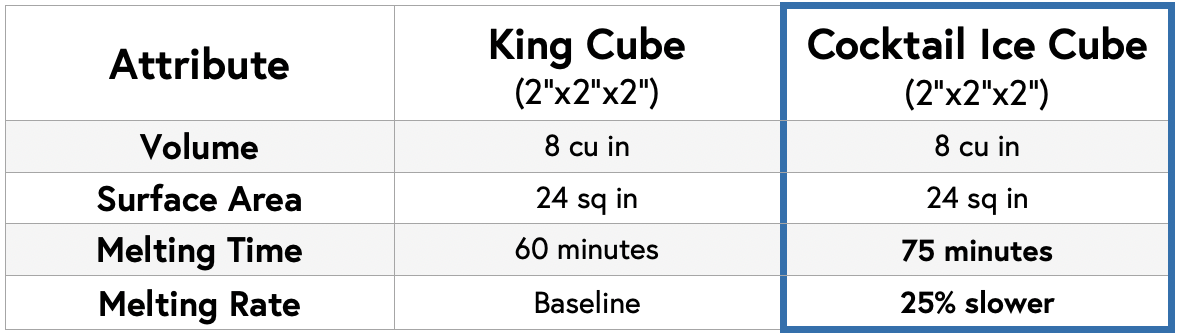
These two types of ice differ by 25%, not because cocktail ice contains different ingredients, but because it lacks what you’d typically find in ice made behind the bar: oxygen bubbles and impurities that come from rapid freezing. Theoretically, this could lead to a customer's drink also being finished approximately 25% faster due to dilution being 25% slower.
In our next example, we’ll compare cocktail ice to regular, smaller ice cubes made in a normal freezer. As mentioned before, all ice in these examples contains identical volumes, and tests are performed under the same conditions:
Cocktail Ice Cube vs Regular sized ice cubes made in a freezer/ice machine:
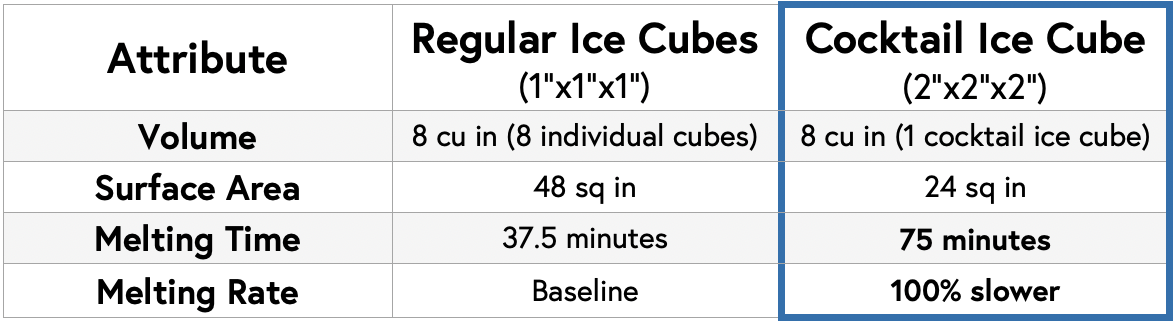
In this example, the cocktail ice is melting 100% slower than regular ice cubes, meaning, for one thing, a far less watered down drink for the consumer and either a faster turnover (FOH managers rejoice!) or, like we also mentioned previously, another drink ordered more quickly.
By now, it should be clear (!) that cocktail ice is more than just frozen water. It’s an integral part of the drinking experience. Whether you run a restaurant, bar, or event space, cocktail ice from IceSmiths will help you deliver a more enjoyable, less diluted, great looking beverage. We hope these examples and explanations shed light on why we’re pragmatically passionate about ice…even when it involves lugging around 300 lb blocks and working in bone-chilling conditions. If you’re ready to learn more about us, you’d like to request a quote/sample, or you’d simply like to introduce yourself, we’d love to hear from you. Sláinte!
- Erin & Chris
clear ice
•
full hearts
•
can't lose
•
clear ice • full hearts • can't lose •